
Q1.
Assertion (A): No two magnetic field lines are found to cross each other.
Reason (R): The compass needle cannot point towards two directions at the point of intersection of two magnetic field lines.
CBSE 2025
Q2.
Assertion (A) : Magnetic field lines around a bar magnet never intersect each other.
Reason (R) : Magnetic field produced by a bar magnet is a quantity that has both magnitude and direction.
CBSE 2025
Q3.
Assertion (A) : The deflection of a compass needle placed near a current carrying wire decreases when the magnitude of an electric current in the wire is increased.
Reason (R) : Strength of the magnetic field at a point due to a current carrying conductor increases on increasing the current in the conductor.
CBSE 2024
Q4.
Assertion (A) : The pattern of the magnetic field of a solenoid carrying a current is similar to that of a bar magnet.
Reason (R): The pattern of the magnetic field around a current carrying conductor is independent of the shape of the conductor.
CBSE 2025
Q5.
Assertion (A): In the common domestic circuits the earth wire is connected to the metallic plate buried deep inside the earth.
Reason (R): Earth wire ensures that any leakage to the metallic body of the appliance keeps its potential difference to that of the earth, so the user may not get a severe electric shock.
CBSE 2025
Q6.
Which one of the following statements is not true about a bar magnet ?
(a) It sets itself in north-south direction when suspended freely.
(b) It has attractive power for iron filings.
(c) It produces magnetic field lines.
(d) The direction of magnetic field lines inside a bar magnet is from its north pole to its south pole
CBSE 2025
Q7.
The strength of magnetic field produced inside a long straight current carrying solenoid does not depend upon:
(a) number of turns in the solenoid
(b) direction of current flowing through the solenoid
(c) material of the core filled inside the solenoid
(d) radius of the coil of the solenoid
CBSE 2025
Q8.
The pattern of the magnetic field produced inside a current carrying solenoid is
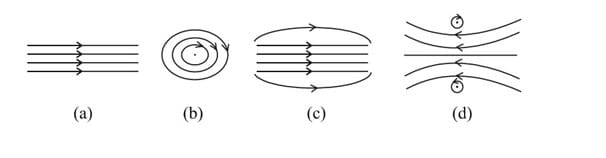
CBSE 2024
Q9.
A uniform magnetic field exists in the plane of paper as shown in the diagram.
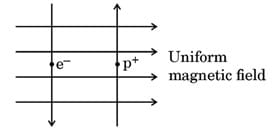
In this field, an electron (e–) and a positron (p+) enter as shown. The electron and positron experience forces :
(A) both pointing into the plane of the paper.
(B) both pointing out of the plane of the paper.
(C) pointing into the plane of the paper and out of the plane of the paper respectively. (D) pointing out of the plane of the paper and into the plane of the paper respectively.
CBSE 2024
Q10.
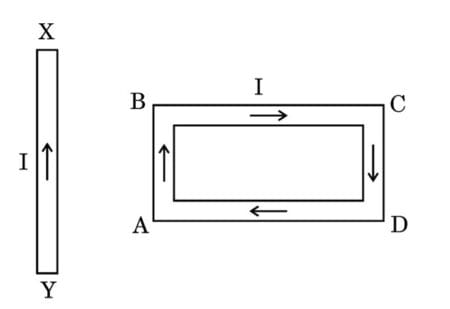
A rectangular loop ABCD carrying a current I is situated near a straight conductor XY, such that the conductor is parallel to the side AB of the loop and is in the plane of the loop. If a steady current I is established in the conductor as shown, the conductor XY will
(a) remain stationary
(b) move towards the side AB of the loop
(c) move away from the side AB of the loop
(d) rotate about its axis.
CBSE 2024
Q11.
The given figure shows the current passing through the straight conductor XY.
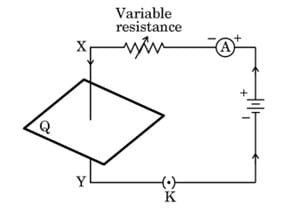
(i) Copy the diagram and draw the magnetic field lines when current flows from conductor X to Y.
(ii) Name and state the rule used in determining the direction of the magnetic field lines in the situation given above.
(iii) State Fleming’s left-hand rule. Using this rule, determine the direction of force applied on an electron entering a uniform magnetic field as shown in the figure.
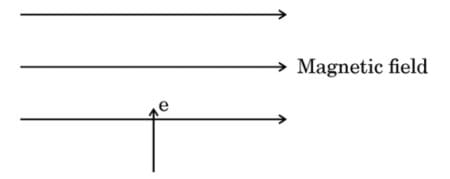
CBSE 2025
Q12.
(i) Define the term solenoid.
(ii) Draw the pattern of the magnetic field lines in and around a current carrying straight solenoid.
(iii) Mark on the pattern the (a) direction of current, (b) direction of field lines near the ends of the solenoid, and (c) region where the magnetic field is uniform.
(iv) How would you make an electromagnet using a current carrying solenoid ?
CBSE 2025
Q13.
Consider a rectangular cardboard having two holes P and Q through which a current carrying circular loop has been inserted as shown in the diagram.
(a) Make this diagram on your answer sheet and draw three magnetic field lines, one each passing through the points 1 (near P), 2 (at the centre of the loop) and 3 (near Q).
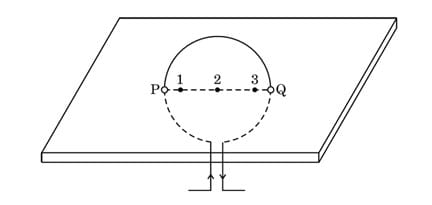
(b) List two factors on which the intensity of the magnetic field produced at the centre of the loop depends.
(c) Name the rule you will apply to determine the direction of magnetic field produced due to a current carrying straight conductor.
CBSE 2024
Q14.
Draw the pattern of the magnetic field lines for the two parallel straight conductors carrying current of same magnitude ‘I’ in opposite directions as shown. Show the direction of magnetic field at a point O which is equidistant from the two conductors. (Consider that the conductors are inserted normal to the plane of a rectangular cardboard.)
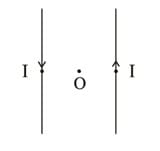
CBSE 2025
Q15.
In our houses we receive A.C. electric power of 220 V. In electric iron or electric heater cables having three wires with insulation of three different colours — red, black and green are used to draw current from the mains.
(a) What are these three different wires called? Name them colour-wise.
(b) What is the potential difference between the red wire and the black wire?
(c) What is the role of the wire with green insulation in case of accidental leakage of electric current to the metallic body of an electrical appliance?
CBSE 2025
Q16.
How is uniform magnetic field in region is represented. Support your answer with a diagram.
Q17.
By using the given experimental set-up. How can it be shown that
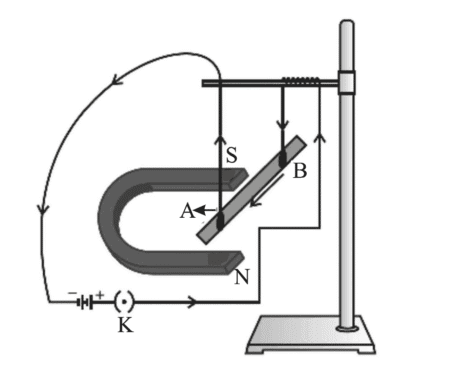
(a) a force is exerted on the current-carrying conductor AB when it is placed in a magnetic field.
(b) the direction of force can be reversed in two ways.
(c) When will the magnitude of the force be highest?
CBSE 2025
Q18.
“The third wire of earth connection is very important in domestic electric appliance.” Justify this statement.
Q19.
(a) What is short circuit?
(b) What is overloading in domestic electric circuit?
(c) List two precautions to be taken to avoid overloading of domestic electric circuit.
Q20. CASE STUDY
In order to obtain magnetic field lines around a bar magnet, a student performed an experiment using a magnetic compass and a bar magnet. The magnet was placed on a sheet of white paper fixed on a drawing board. Using magnetic needle he obtained on the paper a pattern of magnetic field lines (as shown below) around the bar magnet.
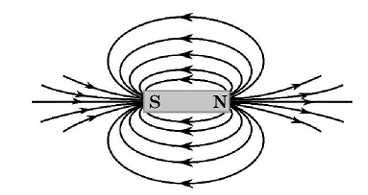
(a) By convention, the field lines emerge from north pole and merge at south pole. Why? Give reason.
(b) State the relationship between strength of the magnetic field and the degree of closeness of the field lines.
(c) (i) No two field lines can ever intersect each other. Give reason.
(ii) The magnetic field in a given region is uniform. Draw a diagram to represent it.
CBSE 2024
Q21. CASE STUDY
In our homes, we receive the supply of electric power through a main supply also called mains, either supported through overhead electric poles or by underground cables. In our country the potential difference between the two wires (live wire and neutral wire) of this supply is 220 V.
(a) Write the colours of the insulation covers of the line wires through which supply comes to our homes.
(b) What should be the current rating of the electric circuit (220 V) so that an electric iron of 1 kW power rating can be operated?
(c) What is the function of the earth wire? State the advantage of the earth wire in domestic electric appliances such as electric iron.
(d) List two precautions to be taken to avoid electrical accidents. State how these precautions prevent possible damage to the circuit/appliance.
CBSE 2025