
Q1.
When we change loud sound to soft/feeble sound, we
(a) increase its frequency
(b) decrease its amplitude
(c) increase its wavelength
(d) decrease its speed
Q2.
Before playing the orchestra in a musical concert, a sitarist tries to adjust the tension and pluck the string suitably. By doing so, he is adjusting-
(a) intensity of sound only
(b) amplitude of sound only
(c) frequency of the sitar string with the frequency of other musical instruments
(d) loudness of sound
Q3.
In the given curve, half the wavelength is
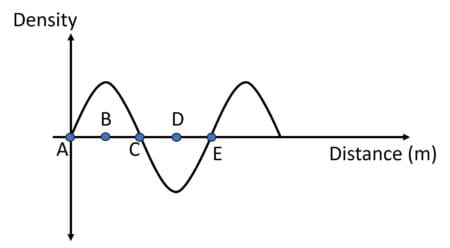
(a) A B
(b) B D
(c) D E
(d) A E
Q4.
Propagation of wave transfers:
(a) energy only
(b) matter only
(c) both energy and matter
(d) none of these
Q5.
The characteristic of sound which enables us to distinguish one sound from another having the same pitch and loudness is-
(a) frequency
(b) wavelength
(c) timber
(d) intensity of sound
Q6.
Assertion: Compression is a region of high density and pressure.
Reason: The particles of the medium in compression region are closer than they normally are.
Q7.
Assertion: Sound is a transverse wave.
Reason: when sound travels through air, the particles of the medium vibrate in a direction parallel to the direction of wave propagation.
Q8.
Establish the mathematical expression which relates speed of sound with wavelength and frequency of sound.
Q9.
Which wave property determines
(a) pitch
(b) loudness ?
Q10.
Graphically represent a sound wave and label the following:
(a) wavelength
(b) amplitude
(c) crest
(d) trough
Q11.
The frequency of a vibrating object is 11Hz. Calculate the wavelength of the sound wave produced by it given the speed of sound wave in air is 330 m/s. Is the sound audible to humans? Give reason.
Q12.
Draw a curve showing density or pressure variations with respect to distance for a disturbance produced by sound.
Mark the position of compression and rarefaction on this curve.
Q13.
Represent graphically by two separate diagrams in each case
(i) Two sound waves having the same amplitude but different frequencies.
(ii) Two sound waves having the same frequency but different amplitudes.
Q14.
A body is vibrating 6000 times in one minute. If the velocity of sound in air is 330 m/s. Find
(i) Frequency of vibration.
(ii) Wavelength of the wave produced.
Q15.
A bat can hear sound at frequencies up to 120 kHz. Determine the wavelength of sound at this frequency. Take speed of sound as 344 m/s.
Q16.
A source produces 60 compressions and 60 rarefactions in 0.3 seconds. Find its frequency.
Q17.
A sound wave causes the density of air at a place to oscillate 1200 times in 2 minutes. Find the time period and frequency of the wave.
Q18.
Flash and thunder are produced simultaneously. But thunder is heard a few seconds after the flash is seen, why?
Q19.
The given figure shows a snapshot of a wave-form of frequency 50 Hz. For this wave motion, Calculate from the graph the following-
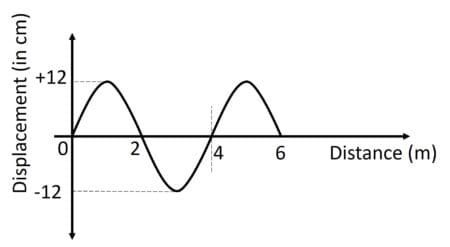
(i) wavelength in SI unit
(ii) velocity of the wave
Q20.
A stone is dropped from the top of a tower 500 m high into a pond of water at the base of the tower. When is the splash heard at the top? Given, g = 10 m s–2 and speed of sound = 340 m s–1.
Q21.
Which characteristic of the sound helps you to identify your friend by his voice while sitting with others in a dark room?
Q22.
A person is listening to a tone of 400 Hz sitting at a distance of 500 m from the source of the sound. What is the time interval between successive compressions from the source?
Q23.
Differentiate between transverse wave and longitudinal wave with one example of each.
Q24.
Why sound waves are called mechanical waves?
Q25.
Define the following terms:
(a) wavelength
(b) frequency
(c) amplitude
Write the SI unit of each term
Answer key for numericals
Ans 11: wavelength = 30 m
Ans 14: Frequency = 100 Hz, wavelength = 3.3 m
Ans 15: 0.28 cm
Ans 16: Frequency = 200 Hz
Ans 17: Frequency = 10 Hz, Time period = 0.1 second
Ans 19: wavelength = 4m, velocity = 200 m/s
Ans 20: T = 10 sec + 1.47 second
(time taken for stone to fall = 10 sec and time taken for sound to reach top = 1.47 sec)
Ans22: T = 0.0025 second